 Free Shipping
 2-Year Warranty
 30-Day Money Back Guarantee



What VOCs Are Released Indoors and How Air Purifiers Help Reduce Them

Volatile Organic Compounds, commonly referred to as VOCs, are gases released into indoor air from a wide range of everyday materials. While many VOCs are invisible and odorless, others create noticeable smells and contribute to indoor air quality concerns over time. Understanding where these compounds come from and how they behave indoors is the first step toward reducing their presence.
Common Sources of Indoor VOCs
Indoor environments often contain higher VOC concentrations than outdoor air. This is largely due to modern building materials and household products that continuously release gases into enclosed spaces.
Common indoor VOC sources include:
- Paints, primers, and finishes
- Pressed wood furniture and cabinetry
- Flooring materials, adhesives, and sealants
- Cleaning sprays and detergents
- Air fresheners and scented products
- Cooking activities and fuel combustion
Even products labeled as low odor can emit VOCs over time. In homes with limited ventilation, these compounds can accumulate and linger in the air.

How VOCs Behave Indoors
Once released, VOCs disperse throughout a space and can remain airborne for extended periods. Some compounds settle into fabrics, carpets, and furniture, slowly re-emitting back into the air. This cycle makes VOCs difficult to manage through ventilation alone, especially during colder months or in tightly sealed buildings.
Because VOCs exist as gases rather than particles, traditional particle filtration methods are not enough to address them effectively.
How a VOC Air Purifier Helps Reduce Indoor VOCs
A VOC air purifier is designed to address gaseous pollutants rather than just airborne particles. The most effective systems rely on adsorption rather than simple filtration.
Activated carbon plays a central role in VOC reduction. Its porous structure attracts and holds gaseous compounds, removing them from circulation as air passes through the system.
Why Activated Carbon Matters
An activated carbon air purifier uses specially treated carbon media to capture VOC molecules. The larger and more substantial the carbon filter, the greater its capacity to reduce odors and chemical compounds released indoors.
Unlike basic filters, activated carbon does not rely on airflow resistance alone. Instead, it interacts directly with VOCs, making it a critical component in any air purifier with an activated carbon filter.
Puraclenz Core and VOC Reduction
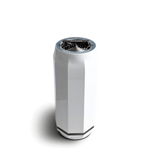
Puraclenz Core is designed to address a wide spectrum of indoor air pollutants, including VOCs generated by household materials and daily activities. Its system combines advanced airflow design with activated carbon media to support ongoing VOC reduction.
Rather than masking odors, the Core system focuses on reducing airborne compounds at the source as air circulates through the unit. This approach supports more consistent indoor air conditions over time.
When VOC Reduction Becomes Especially Important
VOC levels often increase during renovations, new furniture installations, painting projects, or seasonal changes when windows remain closed. In these situations, relying solely on ventilation may not be practical or effective.
Using a VOC air purifier with activated carbon can help manage these spikes by continuously reducing gaseous compounds as they are released.
Understanding Long-Term Indoor VOC Management
Reducing VOCs indoors is not a one-time task. Many materials emit gases gradually, sometimes for months or years. Pairing mindful product choices with consistent air purification offers a more reliable approach to maintaining lower VOC concentrations.
By understanding what VOCs are released indoors and how air purifiers help reduce them, homeowners can make more informed decisions about indoor air purification strategies.

How the Puraclenz Core Carbon Layer Helps Reduce VOCs
Puraclenz Core includes a dedicated carbon layer within its filter system designed to absorb VOCs released into indoor air. As air moves through the unit, gaseous compounds interact with the carbon surface, where they are captured and held rather than recirculated back into the space.
This carbon layer is specifically engineered to address VOCs produced by common indoor sources such as furnishings, finishes and household products. Because VOCs exist as gases, they require adsorption rather than particle filtration alone.
By integrating activated carbon into its filtration design, Puraclenz Core supports ongoing VOC reduction as part of continuous air circulation. This layered approach allows the system to address both airborne particles and gaseous pollutants within the same purification process.
Recommended products

Core Air & Surface Purifier + HEPA
$649.99
Recommended articles

